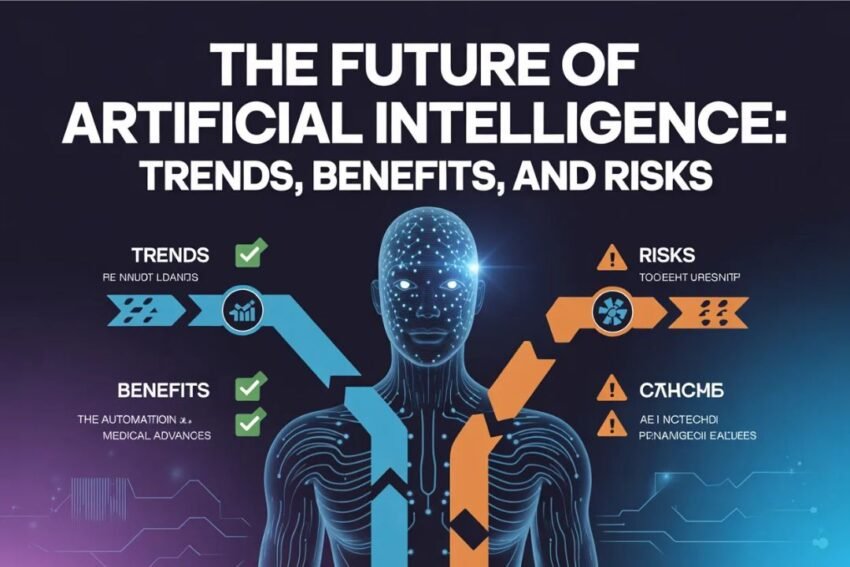
Artificial Intelligence (AI) is no longer just a futuristic concept — it’s a driving force shaping industries, businesses, and our daily lives. From self-driving cars to smart personal assistants, AI is transforming how we work, communicate, and solve problems. But what does the future of AI look like, and what trends should you watch closely in the coming years?
In this article, we explore the most important AI trends in 2026 and beyond, why they matter, and how they will affect everyday life, businesses, and technology.
1. AI Will Become More Human-Like
One of the biggest trends is human-like AI interaction. AI systems are learning to understand context, emotions, and subtle human cues.
What This Means
- Virtual assistants will understand tone and sentiment
- AI chatbots will provide more natural conversations
- Machines may predict user needs before asking
Impact
- More personalized experiences
- Improved mental health support through AI companions
- Enhanced customer service
AI that mimics human behavior will make interactions more intuitive, natural, and efficient.
2. AI in Everyday Devices Will Explode
In 2026, AI is not just in computers and smartphones — it’s everywhere.
Examples
- Smart homes: AI controlling lighting, temperature, and security
- Wearables: AI tracking health, sleep, and activity patterns
- Vehicles: Self-driving and semi-autonomous cars learning road behavior
- Appliances: Refrigerators suggesting recipes, ovens adjusting cooking times
AI integration into devices will make everyday life more convenient and efficient.
3. AI and Automation Will Redefine Work
AI-powered automation is already transforming industries, but the future will bring even more advanced capabilities.
Applications
- Manufacturing: Robots with AI predicting maintenance needs
- Finance: AI analyzing massive data sets for predictions
- Marketing: Automated campaigns with real-time optimization
- Customer Support: Chatbots handling complex queries
Trend
Jobs will shift from repetitive tasks to strategic, creative, and interpersonal roles. Workers will collaborate with AI systems rather than compete against them.
4. Generative AI Will Become Mainstream
Generative AI, which creates content from scratch, is growing rapidly.
What It Can Do
- Generate articles, stories, or social media posts
- Create images, music, and videos
- Develop marketing campaigns and branding materials
Impact
- Businesses can produce content faster and cheaper
- Creative industries will have AI collaborators
- Education will benefit from AI-generated learning materials
Generative AI is moving from novelty to everyday productivity tool.
5. AI Ethics and Responsible AI Will Gain Focus
As AI becomes more powerful, ethical concerns are rising.
Key Areas
- Data privacy and security
- Bias and fairness in AI algorithms
- Transparency and accountability in AI decisions
Trend
- Governments and organizations will implement AI regulations
- Businesses will adopt responsible AI frameworks
- Users will demand transparency in AI decisions
Ethical AI is not optional — it’s becoming a requirement for trust and adoption.
6. AI Will Enhance Healthcare
Healthcare is one of the fields most impacted by AI.
Current Trends
- AI-assisted diagnostics for early disease detection
- Predictive analytics for patient care
- Virtual health assistants
Future Impact
- Personalized medicine based on genetics and lifestyle
- Faster drug development using AI simulations
- Reduced human error in medical procedures
AI will make healthcare smarter, faster, and more accessible to everyone.
7. AI-Powered Cybersecurity
As technology advances, cyber threats are also increasing. AI will play a critical role in defending against attacks.
Applications
- Detecting anomalies in networks
- Predicting potential security breaches
- Automating threat response
AI in cybersecurity will protect personal data, business information, and critical infrastructure.
8. AI in Education and Learning
Education will be transformed by AI-powered tools that personalize learning.
Trends
- Adaptive learning platforms adjusting to student pace
- AI tutors providing explanations and practice exercises
- Automated grading and feedback
Impact
- Students learn more efficiently
- Teachers focus on mentoring rather than repetitive grading
- Education becomes accessible worldwide
AI will democratize learning, making quality education available to more people.
9. AI in Business Intelligence and Decision-Making
Businesses increasingly rely on AI for data-driven decisions.
Future Trends
- Real-time predictive analytics for sales and operations
- Automated business reporting and insights
- AI recommending strategies for growth
Benefits
- Faster and more accurate decision-making
- Better customer insights and personalization
- Cost reduction through optimized processes
AI will be central to how businesses stay competitive in 2026 and beyond.
10. AI in Creativity and Entertainment
AI will continue to push boundaries in creative industries.
Applications
- AI-generated music, art, and scripts
- Video game AI creating immersive experiences
- Personalized content for streaming platforms
Impact
- More opportunities for artists and creators
- Audience experiences become interactive and tailored
- Entertainment production becomes faster and more diverse
AI is transforming how we create and consume content.
11. AI and the Internet of Things (IoT)
AI and IoT will merge to create smarter, connected environments.
Examples
- Smart cities optimizing traffic, energy, and safety
- Industrial IoT predicting maintenance and reducing downtime
- AI-powered sensors for homes and offices
AI+IoT means more efficiency, sustainability, and convenience in daily life.
12. AI Will Improve Accessibility
AI can make technology more inclusive.
Applications
- Speech-to-text for people with hearing impairments
- AI translation for global communication
- Smart assistants helping people with disabilities
AI will ensure everyone has access to technology and information, regardless of physical limitations.
13. AI Regulation and Global Policies
AI growth brings legal and ethical challenges.
What to Expect
- Governments introducing AI governance frameworks
- International standards for AI safety and ethics
- Businesses adopting AI risk management policies
Responsible AI governance will be essential to balance innovation and safety.
14. AI Will Drive Economic Growth
AI will be a major economic engine in the coming decade.
Predictions
- Increased productivity across industries
- Reduced operational costs
- New job creation in AI-related fields
Impact
Companies that adopt AI early will gain a competitive edge, while those who ignore it risk falling behind.
15. AI and Human Collaboration
The future of AI is not about replacing humans — it’s about enhancing human capabilities.
Trends
- Hybrid teams of humans and AI
- AI assisting decision-making, research, and creativity
- AI providing personalized coaching and guidance
Humans and AI working together will solve complex problems faster than either could alone.
Conclusion — Preparing for the AI Future
Artificial Intelligence is not just a tool; it is a fundamental shift in how we live and work. The trends for 2026 and beyond show that AI will become:
- More human-like in interaction
- Integrated into everyday devices
- Essential in healthcare, business, education, and creative industries
- Governed by ethical and regulatory frameworks
- A partner in human collaboration